


Ceramic Fiber Wool Module
Compressed ceramic fiber blanket is used to make IKING GROUP Kingwool ceramic fiber wool modules. The ceramic fiber module (folding/layered block) is processed by skilled workers using industrial machinery to fold the ceramic fiber blanket using folding or cut blocks. Accurate size and a smooth...
- Fast Delievery
- Quality Assurance
- 24/7 Customer Service
Product Introduction
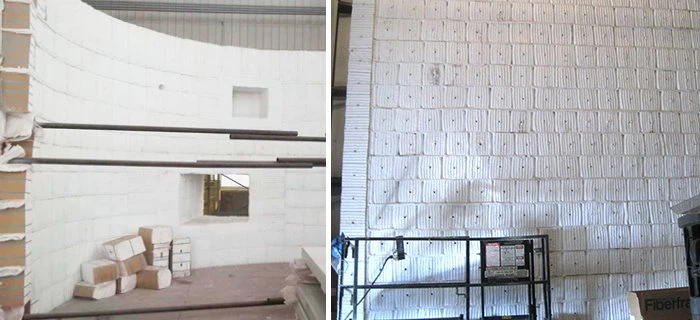
Compressed ceramic fiber blanket is used to make IKING GROUP Kingwool ceramic fiber wool modules. The ceramic fiber module (folding/layered block) is processed by skilled workers using industrial machinery to fold the ceramic fiber blanket using folding or cut blocks. Accurate size and a smooth surface are its benefits. It can be applied to the liner of furnaces and other thermal equipment. Reliable product quality, quick installation, and high thermal insulation performance are key features.
The reinforced H-shaped anchor portion is what the fiber module anchor system uses. The H-shaped anchor component is quite strong. It is nearer the frigid surface. To ensure its high temperature intensity, the anchor is low at high temperatures.
| Description | Common Standard | High Purity Type | High Alumina Type | Zirconia Type |
Density (kg/m3) | 160-240 kg/m3 | |||
Shrinkage(%)of heating 24 hours | 1000℃ x 24h ≤2.5 | 1100℃ x 24h ≤2.5 | 1200℃ x 24h ≤3.0 | 1350℃ x 24h ≤3.0 |
Thermal conductivity (w/m.k)(Density 128 kgs/ m3) | 0.10(400°C) | 0.10(400°C) | 0.16(600°C) | 0.19(800°C) |
0.18(800°C) | 0.20(800°C) | 0.26(1000°C) | 0.26(1000°C) | |
Product attributes:
exact size,
level surface,
quickly installing,
superior performance in thermal insulation
Applications:
Industrial Furnaces: Ceramic fiber wool modules are widely used to line the walls, roofs, and doors of industrial furnaces, including rotary kilns, tunnel kilns, shuttle kilns, and batch kilns. They provide excellent insulation and help maintain high temperatures inside the furnace.
Boilers: Modules are used to insulate boilers in power plants, chemical plants, and other industrial facilities. They provide thermal insulation to improve energy efficiency and reduce heat loss.
Petrochemical and Refining Industry: Ceramic fiber wool modules are used in equipment such as reformers, heaters, and cracking units in the petrochemical and refining industry. They provide thermal insulation and help withstand high-temperature processing.
Heat Treating Equipment: These modules are employed in heat treating furnaces and ovens used in the manufacturing of metal parts. They provide efficient insulation for processes such as annealing, tempering, and hardening.
Aluminum and Non-Ferrous Metal Industry: Ceramic fiber wool modules are used in aluminum melting and holding furnaces. They help conserve energy, improve temperature control, and reduce maintenance downtime in aluminum processing facilities.
Glass Manufacturing: Modules are applied in glass melting furnaces and annealing lehrs. They contribute to energy efficiency and help maintain consistent high temperatures required in the glass manufacturing process.
Ceramic and Porcelain Industry: Used in kilns and ovens for firing ceramic and porcelain products. They provide uniform and efficient insulation, ensuring the quality of fired products.
Incinerators: Ceramic fiber wool modules are used to line the combustion chambers of waste incinerators. They provide excellent thermal insulation and help maintain high-temperature conditions necessary for effective waste disposal.
Steel Industry: Modules are employed in ladle covers and tundishes in steel mills. They provide insulation in these critical areas of the steelmaking process, ensuring the quality of molten steel.
Commercial Baking Ovens: Used in commercial baking ovens to provide efficient insulation, ensuring even baking and energy efficiency in bakeries and food processing facilities.
Automotive Industry: Ceramic fiber wool modules are used in heat treatment furnaces for hardening and tempering automotive components, such as gears, crankshafts, and bearings. They provide precise temperature control and contribute to the production of high-quality automotive parts.
Aerospace Industry: Employed in aerospace manufacturing for heat treatment processes required in the production of aircraft and spacecraft components. They provide efficient and uniform insulation in high-temperature applications.
No Information


