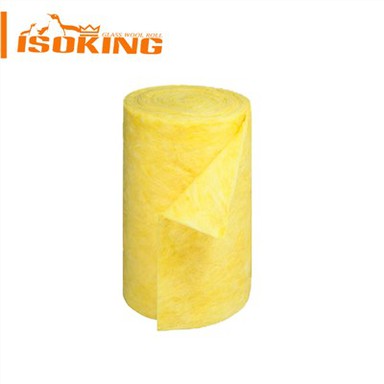
Glass Wool for Soundproofing
Density :10kg/m3 to 48kg/m3
Thickness :Normally 50/75/100mm
Width :Normally 50/75/100mm
Length :10000-30000mm
- Fast Delievery
- Quality Assurance
- 24/7 Customer Service
Product Introduction
Specifications:
Density | 10kg/m3 to 48kg/m3 |
Thickness | Normally 50/75/100mm |
Width | 400/600/1200mm |
Length | 10000-30000mm |
Overview of ISOKING TM Glass Wool For Soundproofing:
ISOKING TM complete glass wool production lines employing latest-generation technology to manufacture boards, slice, rolled blankets and pipes for residential and industrial thermal and acoustic insulation needs, in compliance with the top international standards (EN, DIN, ASTM).
ISOKING TM glass wool is mainly with four kinds of colors, which are yellow, white, pink and black, as well as four different facing which are FSK, Kraft, white cover, and BGT. It is used for thermal and sound insulation of lightweight partition walls, stairwells and elevator shafts, adjacent walls, inner surfaces of exterior walls.
ISOKING TM glass wool production lines range from 5 to 700 tons/day capacity (100,000 to 1,500,000 tons/year), and are fully automated thanks to PLC and SCADA systems.
Safety Reminders for Loading, Unloading, Shipping and Storing:
• These operations should be done indoors in case of rainy weather conditions.
• Loading and unloading should be done by (at least) two people.
• Products should be wrapped by a waterproof cover even if the shipping distance is short.
• Products should not be superposed with pallets.
• Products should be in packages (10 each) and maximum 6 packages can be superposed.
• Before binding, hard cardboards (minimum 20 x 50 cm) should be put on the corners of packages to protect against possible damages by ropes.
• Storage area should be protected against any wet threats such as rain, float, etc. Indoor spaces should be preferred.
• The packages should be put on the floor with extra care so the corners of the product especially is not damaged by a hit.
Applications of ISOKING TM Glass Wool For Soundproofing:
Interior Walls: Glass wool panels can be installed within interior walls to reduce sound transmission between rooms or between different parts of a building. This is especially useful in residential buildings, hotels, offices, and other places where privacy and noise reduction are essential.
Ceilings: Glass wool acoustic ceiling tiles are used to improve the acoustics of spaces by absorbing sound waves. These tiles are commonly used in offices, classrooms, conference rooms, theaters, and auditoriums to create a quieter environment.
Partition Walls: Glass wool insulation can be installed within partition walls to enhance soundproofing between rooms. This is valuable in commercial spaces, hotels, and apartments where multiple rooms share a common wall.
Floors: Glass wool underlayment can be used under flooring materials to reduce impact noise, such as footsteps or furniture movement. This is particularly beneficial in apartments, hotels, and multi-story buildings where noise from upper floors can be disturbing to lower floors.
Recording Studios: Glass wool panels are widely used in recording studios to create a controlled acoustic environment. These panels are strategically placed to absorb sound reflections and prevent external noise from entering, ensuring high-quality audio recordings.
Home Theaters: Glass wool insulation is used to soundproof home theaters, ensuring that sound from movies or music doesn't disturb other parts of the house. It also enhances the audio experience within the theater room by reducing echoes and improving sound clarity.
Industrial Spaces: Glass wool panels are used in industrial facilities to control noise generated by machinery and equipment. They are installed on walls and ceilings to create a quieter working environment for employees.
Hotel Rooms: Glass wool insulation can be installed in hotel rooms to reduce noise from adjacent rooms, corridors, or external sources. This enhances the comfort of guests and ensures a peaceful stay.
Gymnasiums: Glass wool panels can be used in gymnasiums to control noise levels during sports activities. They absorb sound, preventing echoes and creating a more pleasant environment for athletes and spectators.
Public Spaces: Glass wool soundproofing solutions are applied in public spaces such as libraries, museums, and galleries to create quiet areas for reading, studying, or contemplation.
Cinemas: Glass wool panels are used in cinema halls to improve acoustics and create an immersive audio experience for moviegoers. They absorb sound reflections, ensuring clear dialogue and rich sound effects.
Distinctive Advantages of ISOKING TM Glass Wool For Soundproofing:
High sound insulation
Fire safety
High thermal insulation
Easy to apply
Lightweight
Product Specifications of ISOKING TM Glass Wool For Soundproofing:
Model | Density (Kg/m3) | Thickness (mm) | Width (mm) | Length (mm) | Thermal conductivity (W/m·K) |
IK-GWR10 | 10 | 50 | 1200 | 30000 | 0.044 |
75 | 1200 | 20000 | |||
100 | 1200 | 15000 | |||
IK-GWR12 | 12 | 40 | 1200 | 30000 | 0.042 |
50 | 1200 | 30000 | |||
75 | 1200 | 20000 | |||
100 | 1200 | 15000 | |||
IK-GWR16 | 16 | 25 | 1200 | 30000 | 0.039 |
50 | 1200 | 15000 | |||
75 | 1200 | 10000 | |||
100 | 1200 | 7500 | |||
IK-GWR24 | 24 | 25 | 1200 | 20000 | 0.036 |
50 | 1200 | 10000 | |||
75 | 1200 | 10000 | |||
100 | 1200 | 5000 | |||
IK-GWR32 | 32 | 25 | 1200 | 20000 | 0.035 |
50 | 1200 | 10000 | |||
75 | 1200 | 10000 | |||
100 | 1200 | 5000 | |||
IK-GWR48 | 48 | 25 | 1200 | 20000 | 0.032 |
50 | 1200 | 10000 | |||
75 | 1200 | 5000 | |||
100 | 1200 | 5000 |
Technical Parameters of ISOKING TM Glass Wool For Soundproofing:
Properties | Symbol | Unit | Description | Tolerance | Standard | ||
Material | - | - | Glass Wool | - | TS EN 13162 | ||
Density | ρ | kg/m3 | 10 to 48 | +/-10% | - | ||
Width | w | mm | 1200 | +/-1,5% | TS EN 822 | ||
Length | l | mm | 1500 | +/-2% | TS EN 822 | ||
Thickness | t | mm | 50 | 75 | 100 | T3 ** | TS EN 823 |
Facing | - | - | Yellow Glass Tissue | - | - | ||
Reaction to fire | - | - | A1 | - | EN 13501-1 | ||
Squareness | Sb | mm/m | max. 5 | - | TS EN 824 | ||
Flatness | Smax | mm | max. 6 | - | TS EN 825 | ||
Dimensional Stability | Δεd | % | max. 1 | - | TS EN 1604 | ||
Declared Thermal Conductivity (10 °C) | lD | W/m.K | 0,035 | - | TS EN 12667/12939 | ||
Thermal Resistance | RD | m2.K/W | 1,40 | 2,10 | 2,85 | - | - |
Water Vapor Diffusion Resistance Coefficient * |
m |
- |
1 |
- |
TS EN 12086 | ||
Specific Heat * | c | kJ/(kg.K) | 0,84 | - | EN 12524 | ||
Dynamic Elasticity * | Edyn | kN/m2 | 0,8 | - | DIN 52214 | ||
Packaging Material | - | - | PE Film | - | - | ||
Other Information | Maximum service temperature on the side faced with glass tissue is 200 °C. | ||||||